
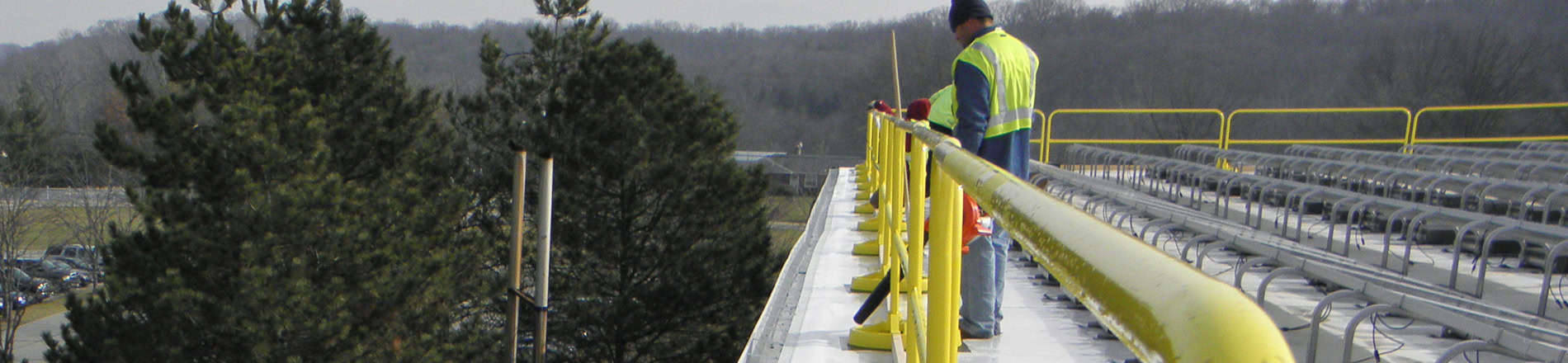
Freestanding Roof Safety Rail
Non-Penetrating & Permanent | OSHA Compliant | 100% Made in USA
Freestanding and Non-Penetrating
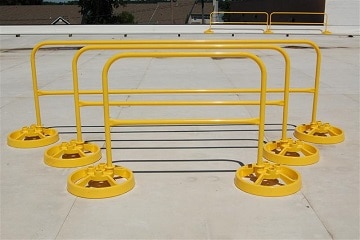
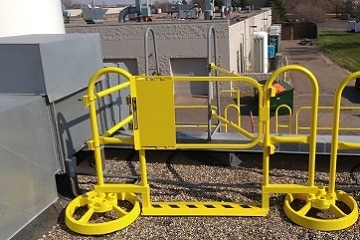
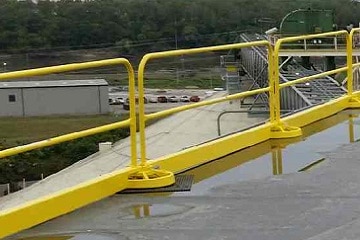
One of the most effective and versatile roof fall protection solutions is Freestanding Roof Safety Rail learn more ». This is a type of non-penetrating guardrail that does not require any drilling, welding, or bolting to the roof surface, thus preserving the integrity of the roof membrane. Standard off the shelf components create a custom fit.
Easy Self-Installation or Turnkey Installation
This rooftop safety rail system is simple to install learn more », remove, or reconfigure to suit different roof layouts and applications. It can also provide a continuous and consistent level of protection along the roof perimeter, as well as around skylights, hatches, vents, and other roof features.
Safer Work Environment
Freestanding Roof Safety Rail can help provide a safer and more compliant roof work environment. Roof safety is a crucial aspect of any building project, especially when working at heights or near edges.
100% OSHA Compliant
This system meets or exceeds OSHA standards and is validated by third-party accredited USA testing labs.
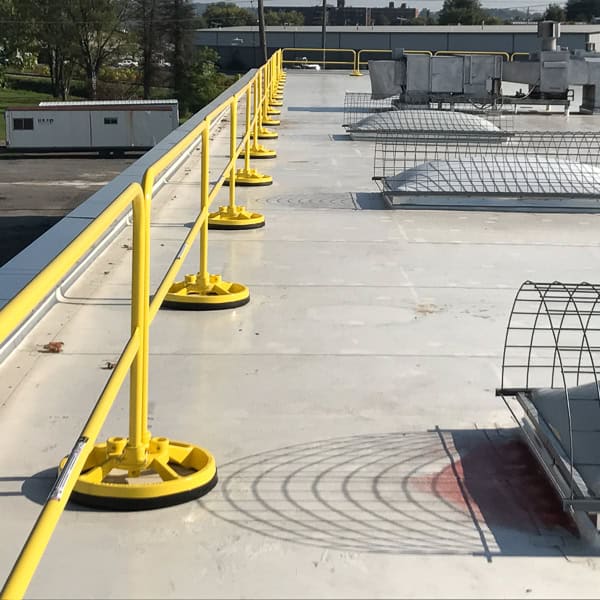
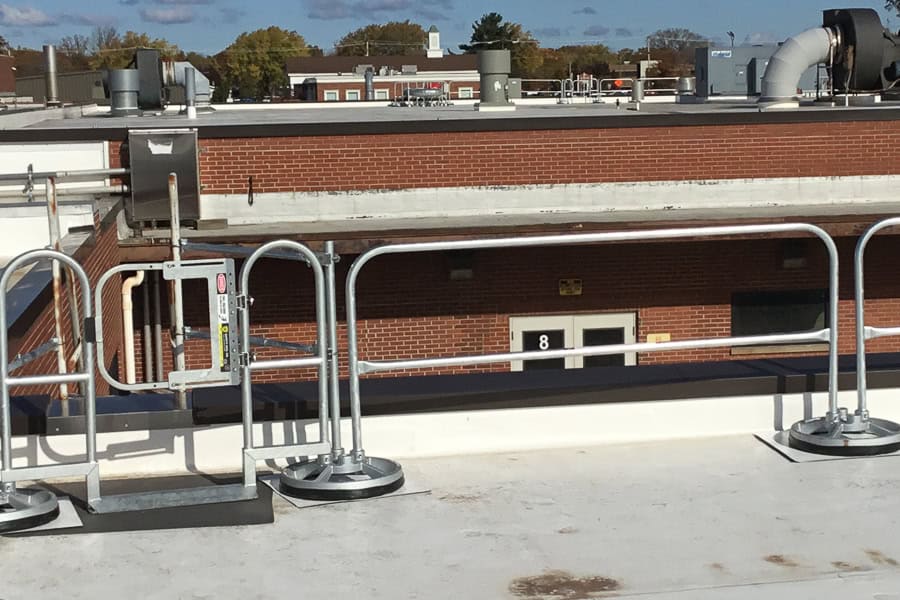
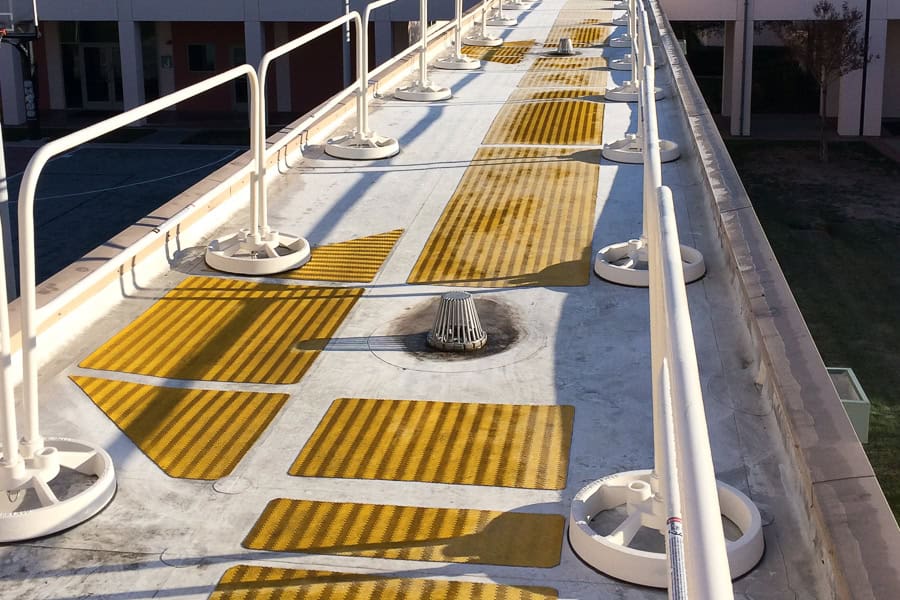
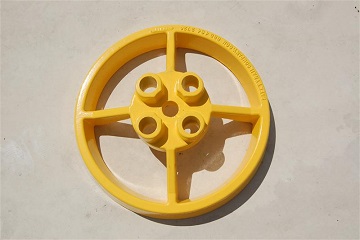
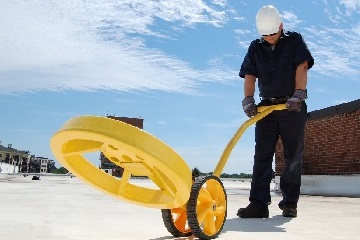
Freestanding Safety Rail Components
Why Choose Freestanding, Non‑Penetrating Roof Safety Rail?
Protect People Without Compromising Your Roof
Freestanding, non‑penetrating Roof Safety Rail provides reliable fall protection without drilling, welding, or altering your roof structure. Designed to sit on the roof surface using counterweighted bases, this fall protection system provides OSHA‑compliance while preserving the integrity of your commercial or industrial building.
Key Benefits for Facility Owners
No Roof Penetrations for Leak Prevention
Traditional guardrails often require drilling into the roof membrane—creating long‑term risks for leaks, water damage, and costly roof repairs. Freestanding, non‑penetrating Roof Safety Rail eliminates these concerns entirely.
- Preserves roof warranties and extends roof lifespan
- Prevents future leak points and water intrusion
- Ideal for new, aging, flat, or low‑slope roofs
Fast, Non‑Disruptive Installation Saves Time and Money
This roof fall protection system installs quickly with minimal disruption to building operations. No hot work, no structural modifications, and no downtime.
- No welding or core drilling required
- Reduced labor and installation costs
- Faster project completion for commercial buildings
Flexible and Modular for Any Roof Layout
Whether your facility has HVAC units, skylights, parapet walls, or varying roof elevations, freestanding, non-perpetrating Roof Safety Rail systems adapt easily.
- Modular and reconfigurable design
- Suitable for flat and low‑slope roofs
- Easily relocated as roof layouts change
OSHA‑Compliant Fall Protection for Worker Safety
Freestanding, non-penetrating Roof Safety Rail is engineered to meet or exceed OSHA fall protection requirements, helping facility owners maintain compliance and reduce liability.
- Protects maintenance staff and contractors
- Reduces risk of accidents, fines, and citations
- Demonstrates proactive safety leadership
Lower Lifetime Cost with Durable, Roof‑Friendly Design
By avoiding roof damage and simplifying installation, freestanding, non‑penetrating Roof Safety Rail often cost less over the life of the building.
- No structural repairs or roof membrane damage
- Minimal maintenance and long‑term durability
- Cost-effective solution for commercial facilities
The Smart Choice for Modern Commercial and Industrial Facilities
From warehouses and manufacturing plants to hospitals, schools, and commercial buildings, this roof fall protection system offers a smart, future‑proof solution for roof fall protection.
They protect your people, your roof, and your investment—without unnecessary complexity.
Planning & Installing Freestanding Safety Rail
Installation Requirements:
- Install on flat level surfaces, not to exceed 1:12 pitch.
- Do not install on slippery surfaces. Remove loose materials like rock and gravel.
- Outriggers (5’ or longer Rail Sections) are required at the ends of each continuous railing run, positioned 90 degrees away from leading edge.
- Outriggers are not qualified for use as fall protection and must be 15’ or greater from an opposing leading edge.
- If parapet height is less than 4”, Bases must be 18” from roof edge.
- Rail Sections must be pinned to Bases using Locking Pins.
Manufacturer’s installation and instruction manual supersedes this document and must be adhered to when installing this system.
Estimating Parts:
- Always add 6” to each Rail Section. For example: 3 each 10’ Rail Sections will create a Freestanding Guardrail run length of 31.5’ plus base extension on leading edge.
- Fixed Rail Section Lengths: 2’, 3’, 4’, 5’, 6’, 7’, 7.5’, 8’, 9’ and 10’.
- Adjustable Rail Sections Lengths: 3'-5' and 6'-10".
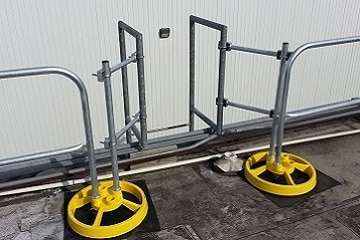
- Spanner Brackets attach Rail Sections to roof ladders.
- Bases extend approximately 11” past vertical posts of Rail Sections.
- 1 each Base per Rail Section, plus 1 each extra Base for each continuous run of Freestanding Guardrail. Do not add an extra Base for entire roof perimeter (continuous).
- Each Base is 22” (D) x 6” (H) and 104lb.